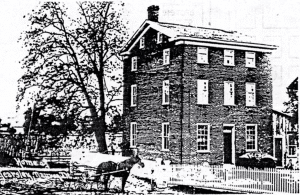
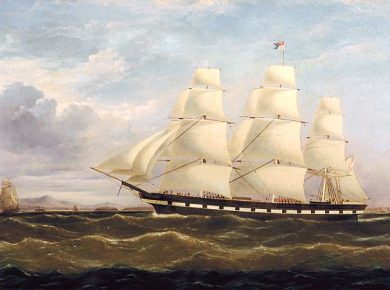
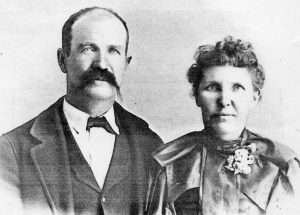
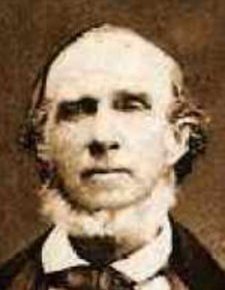
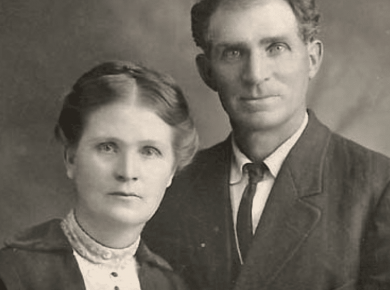
Thomas Grover was born 22nd of July 1807 in Whitehall, New York. His family lived on the northern end of Whitehall which was at the south end of Lake Champlain. At this time moving goods by water ways was big with the Erie Canal. In 1820, Thomas (age 13) was cabin boy on the barges that operated on Lake Champlain. By 1930-31, he had advanced to the position of Captain of the Shamrock, a freight and passenger vessel operated on the entire waterways from Quebec to New York City or Albany westward to Buffalo.
He married Caroline Whiting in 1828, and moved west to Freedom, New York. While living there he learned of the new “Mormon” Gospel. He became interested, investigated it to his complete satisfaction and became a member of it. He was baptized in September 1934 by the Prophet Joseph Smith and Elder Sidney Rigdon.
In late 1835 his family moved to Kirtland to join the Saints and helped work on the temple. They were driven out of Kirkland a year later finally going to Nauvoo. His family had grown to seven children by 1840. His wife Caroline died along with their youngest daughter later that year. He met and married Caroline Eliza Nickerson (a widow). With the revelation given to Joseph Smith, the practice of plural marriage was given Thomas accepted the practice. He was married to six women but never had more than four wives at one time.
Upon joining the Church, Thomas made a gift of considerable size of money to Joseph Smith. He was a member of Zions Camp; he suffered the persecutions of the Mormons in Missouri and was with the prophet in prison a number of times. He fulfilled three missions for the church (in New York State, Canada, and Michigan). He was a member of the first High Council of the Church in Nauvoo (D&C 124:132). He was one of the Prophet Joseph Smith’s bodyguards. When the Prophet was kidnapped, Thomas was one of the men who rescued him.
Thomas was among the first 143 men to go with President Brigham Young in 1847. He left his family with enough provisions to last two years. On the north side of the Platte River it became necessary to build a boat to cross the Platte. President Young called the camp together to ascertain the best plan. Young gave his plan to build a raft but Thomas said, “It will not work”. Young said, “I think it will”.
Thomas again said it would not work in that kind of stream and they went to bed. The next day President Young got his boat into the water and it sank. President Young turned to Thomas and said, “My plan has failed, what is yours?” Thomas soon built another boat but differently than President Young’s. When ready Thomas asked for a large 6000 pound prairie schooner to be loaded on to the boat and then floated the raft across the river. President Young then appointed Thomas and 13 others to remain and run the boat ferry to help other wagon trains cross the river.
He was asked to help settle some business for the Saints in California that had arrived on the sailing ship “Brooklyn”. Then to bring tithing gold dust worth $3000.00 and $1280.00 in coins back to Salt Lake City. In 1850, went back east to Iowa and Missouri to purchase cattle to bring west. Around the spring of 1854, he bought a farm and moved into two log houses. Next spring planted wheat in the warm weather but this was the year of the crickets that came into the area. However, the grain had ripened before the crickets had a chance to do much damage. They harvested 700 bushels which was life-saving for many.
Thomas was in the Utah legislature which was located in Fillmore in 1855 and 1856 of which he served three terms. He moved to a farm in Farmington of which he gave part of the farm ground for the Farmington meeting house. He was appointed to the high council and served until his death. When the Perpetual Emigration Fund was ask for in 1861, he sent one yoke of oxen and a wagon, and sent two yoke of oxen and two wagons each year afterward until the railroad was completed.
Thomas and his family spent the remaining years in the Farmington. One Sunday, upon returning home from Fast meeting, where he had borne a stirring testimony to the truthfulness of the gospel and the Mission of Joseph Smith, he stated he didn’t feel well. He went to bed. He passed away a few days later on February 20, 1886.
Thomas Grover can be known as a Cabin Boy, Boat Captain, Body Guard, Pioneer, Father, Trusted Friend, Cattle Herder, Boat Builder, Farmer, Legislator, Emigration Supporter, and much, much more.
This article originally appeared in Vol.51, No.4 (2004) of Pioneer Magazine. by Mary A. Johnson, President, International Society Daughters of Utah Pioneers It was in 1954 when I first became…
The Yearsleys made their way through the bitter cold winter weather to Winter Quarters. The hardships were so extreme that some entire families were buried along the way. “Thus, from day to day, slowly and wearily traveling, went the exiled Saints across the undulating surface of snow-covered Iowa. The Roads were very bad, the weather cold and stormy, and the streams, now frozen, now swollen by spring freshets, almost and at times quite impassable. Again and again they were obliged to double teams on the heavily loaded wagons, to drag them through deep streams and miry marshes on their line of travel. Some days three or four miles would be the extent of their journey. Many a halt was made, at times for weeks (5).”
This biography originally appeared on pioneerstories.org Owen Roberts was born 21 June 1818 in Llandysilio, Anglesey, Wales. He was the son of John Roberts and Jane Jones. Owen was a…
Ane was a hard worker. She had to work more like a man than a woman. She did a lot of work in the fields and with the animals. When anyone in the family needed help or advice on the farm, they would ask her. She could fix a broken harness as well as any man. She had quite a few sheep that her boys would care for. She would shear her sheep, then wash the wool and spin it into yarn. Following this preparation, she would weave it into beautiful cloth.
Rasmus Johnson was born September 19, 1813 in Falster, Denmark. He was the son of Jens Larsen and Karen Rasmussen. He had nine brothers and sisters named Lars, Rasmus, Kirsten,…
Submitted by Aria Doman, student at Riverside Elementary School in Washington, Utah. Alma Snow Whiting was my Great Grandma, she died just about a year ago and I miss her…
He was evidently very happy in his work because he sang at it, wrote songs and occupied his mind and hands at the same time. His songs were songs of praise and thankfulness to his Heavenly Father for the many blessings received, and the knowledge he had of the true Church.
This pioneer story was submitted by Acacia Barney, as part of the Cotton Mission Chapter’s 4th Grade Student Essay Contest. Mary Jane McCleve Meeks is my great, great, great, great…
Albert Haggerty Petty, mechanic, son of Albert and Lucinda, was born in Manti, March 3, 1854. His father came to Utah in 1848 and located in Salt Lake City. He…
Born in 1857, B.H. Roberts became a historian, and politician, and would serve as President of the First Council of Seventy. But every famous man was also once a boy,…
After travelling over the mountains one day we met with some of our brethren from the Valley. This was a time of rejoicing. Captain Brown who left us at Santa Fe with the sick which went by the way of Fort Kearney and a few brethren with him from the Valley, brought news that we were not to go to the Valley, and told us we had better stay another year in California. So the company divided right where we met each other; some went on to Winter Quarters; some to the Valley, and some turned back. Daniel Browett, Slater, Cox, Levi Roberts and myself turned back to Sacramento and went to work for Mr. Sutter who treated us very kindly. I sent a mule to my wife with Brother Harris, which she got….
We all went to work at the same place for Captain Sutter. We took the work of cutting a millrace. Brother Browett went [p.379] to work with the millwright, this was in September and later on in the fall, I and two others took sick with the bilious fever. We were so sick we couldn't help each other to a drink of water. We lay under some ties and had to crawl around with the sun to keep from making us chill…. Our appetites were very poor, and our food was flour, water and squash. Had it not been for the thoughts of my wife and family I could have died, but we all three recovered after awhile and went to work on the millrace again and worked all winter. Sometime in the winter two of the brethren who were working for Mr. Sutter in the mountains found gold in a tailrace they were making. Mr. Sutter let me see the first gold they found before sending it to San Francisco to get it tested. In May 1848 some of the brethren and myself made a trip in the mountains to try and find a road over (instead of going down Truckee River, as we had to cross it about 20 times) but when we got in the mountains we found so much snow we had to return, and on our way back I stopped at what we called the Mormon Island, where there was some of the brethren at work getting gold, Brother Sidney Willis and his brother; also Brother Hudson. I stayed here for a short time and got some gold.
Later Sarah decided to give up her business in Liverpool and join her family in Utah. Sarah had the means enough for a very comfortable trip across the plains. She had three teams and wagons fixed up for her trip. She brought many nice things from England. For herself she rode in a carriage across the plains.
Catherine Aurelia Carline Porter “I was not twelve years old when we moved to Orderville. Father turned all his property over to the United Order, except the household and personal…
HISTORY OF SHADRACH MONTGOMERY RICHARDSON written April 1926 by Ivy Richardson Francom, Daughter Shadrach Montgomery Richardson was born in Keg Creek, Pottawattamie County, Iowa March 11, 1848, is the son…
Sarah Ann Franks and George Padley: A Love Story Submitted by Michael Jordan Born: 05/09/1832, Shepshed, Leicestershire, England Died: 01/31/1911, Murray, Utah Sarah Ann Franks was born 9 May 1832,…
 0
0
 1
1

 Thomas and his family spent the remaining years in the Farmington. One Sunday, upon returning home from Fast meeting, where he had borne a stirring testimony to the truthfulness of the gospel and the Mission of Joseph Smith, he stated he didn’t feel well. He went to bed. He passed away a few days later on February 20, 1886.


 Brother Joseph