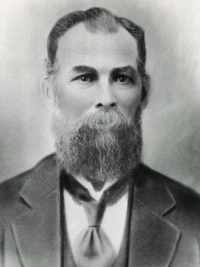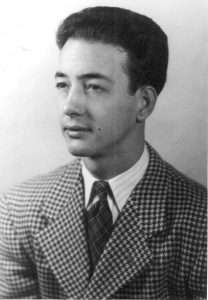
ANDERSON, Robert Kirk: My Great Grandpa Bob

0 1
Read Time:3 Minute, 56 Second

Submitted by Hudson Bradshaw, a student at Arrowhead Elementary School in Santa Clara, Utah.

Robert Kirk Anderson

Robert Kirk Andersen (1921-1999)

I’ve never met my great grandpa Bob, but I’ve heard that he was a great guy. He has lived a very interesting life. He was a very hard worker and very talented at what he did. Everyone loved my great grandpa Bob and they all have nice things to say about him.

He was born in Richfield Utah on January 12, 1921. There were 12 children in his family. He had 8 brothers and 3 sisters.’He was the baby. Although, his parents had a lot of children I’m glad they didn’t stop at 11 or else I wouldn’t be here. During his life he lived in Richfield, Lindon, and later settled in Nephi Utah. Bob loved the outdoors. He enjoyed hunting and fishing. His favorite spot was Fish lake. In fact he loved the outdoors so much that he even built a cabin in Antimony Utah in his later years. His cabin was like Disneyland. He built a large pond with a water wheel and was full of trout. It had a go-kart track that went around the cabin and an archery shooting range. He wanted to make it really fun for his grandkids.

When he was in his early 20s he enlisted in the army and was stationed in India. He served 2 years there. At one point his unit was deployed to the Battle of the Bulge. Before they were shipped out they put them on a 20 mile march which resulted in him developing a sore on his foot and had to be sent to the hospital. His unit was shipped out without him as he was unable to walk. We think he was extremely lucky because it was the third most lethal American war with an estimated 19,276 number of Americans killed. 

Later on in his life he was spending time at Fish Lake and ran into a man that came up to him and said “Bob, do you remember me?” Trying to not be rude he answered ” yes” even though he didn’t. The man came back and said “no you don’t”. He told him his name and my great grandpa realized that he was on his same unit that went to the Battle of the Bulge. He was unrecognizable because his face had been severely damaged during the war.

He met the love of his life Donna Whitely shortly after returning from the army. They were married for 58 years and had 4 children, 3 boys and 1 girl. My great grandpa was a self made man who eventually built and owned motels and other businesses like a car wash and restaurants. He built his businesses from pure hard labor. When he decided to build his first motel he hand dug all the footings and mixed all the concrete. 

El Tonya Motel

Being the ambitious man that he was, he started his project before having finances in place. He decided to go to the bank to get a lone to build the motel. He had no credit at the time but the bank lender said that he had been watching him work on the motel. The banker explained that he would lone anybody that would work that hard. That was the beginning of his business endeavor and it flourished from there. 

Things always didn’t go smooth for him. While building the hotel he constructed a large wall out of cinder block. After 2 days of extensive labor he was finally finished with the wall. There was a large tree in front of the wall that needed to be removed. He hired a guy with a backhoe to pull the tree stump out of the ground. Both of them not knowing that there was a large root from the tree going under the wall as the backhoe operator pulled the tree stump out the root pulled the wall down and it collapsed.

This was very devastating to him so he drove home crying to his wife. She assured him and said “it’s going to be alright.” Her words gave him the motivation to go back and build it again. This time it only took 4 hours.

Bob was a great dad, husband, grandpa, brother, uncle and friend. He was loved by everyone This was really shown at his funeral. The line at his service went out the door and around the block. This went on for hours and hours. I’m so proud to be able to call him my great grandpa!

Happy
Happy
0 %
Sad
Sad
0 %
Excited
Excited
0 %
Sleepy
Sleepy
0 %
Angry
Angry
0 %
Surprise
Surprise
100 %
You May Also Like

ALEXANDER, Abel

Their two year old daughter, Edna, received fatal burns when a pot of freshly made tea was upset, scalding her chest. Due to the shock of the accident as well as the severity of the burn, she died on December 17, 1853. They had to use the funds they had saved to pay for the medical care and burial expenses for their little one.
View Post

DALTON, Charles Wakeman: A True Pioneer

Exploration in the early 1850 's confirmed the southern half of Utah had the potential to grow cotton, grapes, figs, flax, hemp, rice, sugarcane, tobacco and produce iron ore. In May of 1854 Brigham Young sent a group of missionaries under the leadership of Rufus C. Allen to the South. This company arrived in Pine Valley, about 35 miles Northeast of St. George, Utah on the headwaters of the Santa Clara Creek in early spring. Charles W. Dalton and family was in this company.
View Post

GLEASON, John Streator: Rush Valley Miner

John S. Gleason did indeed own the Mountain Lion mine, or parts there-of, but also the Blue Wing mine listed above and much to our surprise, at least seventeen other lodes shown in Figure 13.0. Two miles north of Ophir is Jacobs City in Dry Canyon. Some of the richest lodes of the Ophir Mining District came from this location. John S. Gleason owned in part the Iris(Ira) and Jacobs Hill lodes (Shoo Fly) in Dry Canyon. Millions of dollars of rich metals were taken from the Ophir and Jacobs City locations. The date of sale of the Mountain Lion Lode no. 2 was 4 March 1871. It was sold with the webster and women rights lodes for $2,000 dollars. The Mountain Lion Lode and thirteen other lodes were sold on 10 June 1871 for the combined sum of$5,000 dollars.
View Post

ALLEN, Albern

A court-martial was held by the officers and priests, and without being heard in their own defense, the brethren were sentenced to be shot on Friday morning on the public square in Far West, in the presence of their wives and families. At this unprecedented action General Doniphan objected, saying he would have nothing to do with such cold-blooded actions, and he would draw off his brigade from the army. This probably saved the lives of the prisoners, as the sentence was changed and the prisoners were taken to Independence, Jackson County (3).”
View Post

WOOLSEY, Jacob C. & son Joseph H. : 1848 Pioneers

Jacob C. Woolsey is the "brother-in-law who dug Abigail Lee's grave" at the "9th or Last Crossing of the Sweetwater" on 2 Sep 1848. Abigail Schaeffer is the widow of the above Joseph Woolsey and eight of her twelve children joined the Church and came to Utah! She was married to John D. Lee "for her protection and for convenience of traveling."
View Post

FREESTONE, George: and his Wives, Alice Carlisle and Jennie Lind

George found himself, as a fifteen year-old, driving four yoke of oxen on a heavy freight wagon to the Utah Territory. His younger brother, James, later wrote that he had driven sheep 1,000 miles barefooted across the Plains. “In Alpine,” George wrote, “between 1855 and 1856, I spent about half of my time building forts to fight against the Indians and half my time killing crickets.” The family struggled against these odds to make a living. Then in 1858, they lost their father when he was killed by Indians.
View Post

BARNEY, Lewis

He discovered that the Mormons were a religious people, however, at that time he cared nothing for religion. “The Methodists and the Presbyterians had been trying to convert me to their faith. I came to the conclusion that religion of every kind was a hoax, and that none was right, and that all preachers of religion were hypocrites, and were preaching for money and popularity.”
View Post

BLANCHARD, Amelia Jane Davis

The Davis family, being among the first settlers to Cache Valley, suffered untold privations and hardships. Amelia remembered the trials they had with the Indians, and how frightened she was. They would come to the door begging for food and no one dared to turn them away. As Ann H. fixed food for them, the Indians would play with the white children. When coming out of the house with food one day, Ann H. discovered the Indians had exposed her children to the black smallpox. The twins soon came down with the illness. The settlers were all so frightened of the deadly disease that a log shelter was hurriedly built a short distance north of the Logan Cemetery. The Davis family, including the stricken twins, moved there in isolation. Amelia told of rats, mice, and snakes so thick that the healthy children took turns with willows, brushing the snakes from the beds of the sick children. Their beds located on the floor were made with a straw tick. The weather was severe coming through the open cracks of the shelter. The family was badly neglected and almost starved to death. Remarkably, the twins recovered from the smallpox epidemic, but after being home only a short time, diphtheria struck, taking the lives of both twins, Henry and Catherine. Childhood days were very strenuous and hard. These early settlers had lots of troubles, yet they had some thrilling and good times too. Amelia often told stories of the exciting sleigh rides, dances and house parties they enjoyed. How she loved her church activities! Amelia's greatest desire was to do good for others and scatter sunshine wherever she went.
View Post

ALLEN, Alanson David

His father, Albern, and oldest brother, Rufus, were with the Mormon Battalion on their march to California. They were released on July 16, 1847 and went to Utah. Alanson stayed with his family at Winter Quarters. He was seventeen at the time. Realizing their need for winter supplies, he went back to Eastern Missouri and bought and harvested crops and brought them back to his family at Winter Quarters.
View Post