 0
0
 1
1
(As reported by Mary’s Daughters
Mary-Ann McNeil, Alice Gatliff, and Rose Rasmussen,)
Submitted by DeLoy F. Johnson

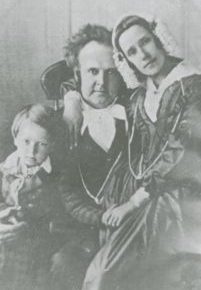
About 4 July 1857, William took his four year old daughter, Mary-Ann and went to St. Louis, Missouri where his Mother, Mary [Smith] Dale lived. He was to find work and be near her as she was reportedly alone. [William’s wife] Mary stayed with a member family in New York until she had means to travel.
Mary said she left the following year to join William and Mary-Ann. The following year Hannah was born to them at Cheltenham, St. Louis, Missouri, on 31 May 1858. They were living in St. Louis when the Civil War broke out in 1861. About 2 June 1862 [t]hey took a steam boat up the Missouri River to Florence, Nebraska; where they remained for six weeks.
Mary said while they were living there they lived under a united order. They were living in a mud-thatched cabin or lean-to which William was helping to build for the migrants. [T]hey were instructed to help plant crops for the forthcoming migration. She said William reported he had nothing to plant or the wherewith to obtain sufficient to plant. Then one day several individuals came and handed off a handful of corn or grain until we had sufficient to sparingly plant on the assigned area.
While living in this mud-thatched [cabin] Mary said she was alone during the day as many of the men had taken work at outlying farms or on the docks. Their cabin was some distance from any community. She said she did laundry, crochet, tatting, and sewing for others. It was on one of those days when . . . suddenly an Indian fell into her cabin holding his belly. She could see his belly had been slashed open exposing his entrails.
Mary said she never was frightened. She said a total calm came over her and she felt she was being directed to help this man. She could tell he was not a Sioux as his ware and cuttings were not the same as she had seen around the area. She said she went to the nearby corrals and secured several strands of horse hair.
When she returned she put them in her hot teapot. Then with her two sewing needles she did a straight line stitch from one end of the laceration to the other, on both sides pulling his belly back together. When she finished he got up and left and was never seen there by any persons.


 Brother Joseph