HOUTZ, Jacob Miller

0 1
Read Time:4 Minute, 9 Second
Jacob Miller Houtz (1814-1896)

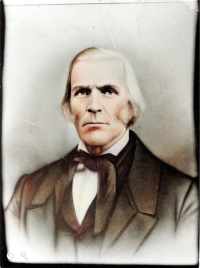
For many years a prominent citizen, both of Salt Lake and Springville, Jacob Houtz made a record as an enterprising and successful man of business, a founder and promoter of various industries. He was born near Selin’s Grove, Union county, Pennsylvania, October 12, 1814, and his boyhood and early manhood were passed in the same locality. His parents were prosperous, owning a fine farm on the banks of the Susquehanna river, and their son received as good an education as the time and place could afford. When not at school he helped his father upon the farm.

Jacob was but seven years old when his mother, Elizabeth Zellir Houtz passed from earth, but he found a good friend in Catherine Zellir, his mother’s sister, who became his father’s second wife. He remained at the old homestead until his own marriage, in January, 1840. The maiden name of his wife was Lydia Mace.

In September, 1844, he became a Latter-day Saint, and at Nauvoo, about two years later, was ordained to the office of a Seventy. Accompanying his people into the wilderness, Mr. Houtz found himself, at the opening of the year 1847, at Council Bluffs and in May of that year he joined the emigration that was being organized near Winter Quarters to follow the Pioneers across the great plains. He was outfitted with two wagons, two ox-teams and a sufficiency of food and clothing for himself and family. They traveled in Daniel Spencer’s hundred, and arrived in Salt Lake valley on the 23rd of September. The Houtzes settled first at Salt Lake City, where the head of the family became a Bishop’s counselor, first to Bishop William Hickenlooper, and afterwards to Bishop Elijah F. Sheets, of the Eighth Ward, holding the latter position until he moved from Salt Lake to Springville.

Meantime, in September, 1852, he was called with Elder Orson Spencer upon a mission to the kingdom of Prussia. They arrived at Hamburg on the 22nd of November, and three days later reached Berlin. Mr. Houtz writes:

‘‘Our passports having been presented to the government officials, we were in due time required to appear at police headquarters, where we were closely scrutinized and thoroughly questioned as to our business, our religion and the causes that brought us to that country. The court, determining that the Gospel as taught by the Latter-day Saints would not be permitted in Prussia, made an order prohibiting its introduction and commanding us to leave Berlin and the kingdom by seven o’clock next morning, and not return, on pain of transportation. We applied to the American legation at Berlin (Messrs. Bernard anil Fay) for such relief as they could give us, but were informed that the laws of Prussia were absolute, the religion national, and that wisdom would dictate obedience to the order. Consequently we returned to Liverpool, reporting to President Samuel Richards, of the British Mission, the unfavorable treatment we had received. We were advised by him to return to America, and lay the matter before Apostle Orson Pratt, then editing “The Seer” at Washington, D. C. We did so, and Brother Pratt advised our return to Utah.”

While yet in the East Elder Houtz visited his birthplace, where he enjoyed a brief stay among his relatives, one of whom, his widowed sister, Mrs. Catherine Boyer, he converted, aud she, with six small children, accompanied him to Utah. He arrived home in September, 1853.

Since 1851 he had been interested in business at Springville, where he had taken up a farm and built a grist mill on Spring Creek, about a mile north of the village. In the spring of 1854 he began at that place the erection of a second flouring mill, and in 1855 completed one of the best mills in the Territory. In 1863, in partnership with William J. Stewart and William Bringhurst, he began the erection of a cotton factory, which was completed in 18GG-7 at a cost of about eighteen thousand dollars. In the spring of 18G8 Mr. Houtz made Springville his permanent home. During the Walker, Blackhawk and other Indian wars he rendered material aid to the fighting frontiersmen in the way of supplies, equipment and other necessaries.- In 18G9 ho fulfilled a mission to the States.

Forty years of his active life were passed in milling, manufacturing, merchandising and farming, but after the year 188S, he followed the more quiet and peaceful labors of fruit and farm culture. His wife Lydia died that year. He had two other wives, and his children in all number fourteen. His death occurred at Springville, December 11, 1896. He was the father of Mrs. Mary E. Snow, wife of the late President Lorenzo Snow, and others of his descendants are well known citizens of the commonwealth.


This article is from History of Utah, Vol.4, by Orson F. Whitney

Happy
Happy
0 %
Sad
Sad
0 %
Excited
Excited
0 %
Sleepy
Sleepy
0 %
Angry
Angry
0 %
Surprise
Surprise
100 %
You May Also Like

POND, Stillman Pond

On February 2nd 1846 the migration west began. Stillman and his family remained in Nauvoo until after the battle of Nauvoo in September 1846 when they were driven at the point of a bayonet across the river. Tribulations and hardships were many as the winter set in early and the Mormon refugees were without the proper food, clothing and shelter. The camp was ravaged by malaria, cholera, and consumption. The Pond family fell victim of all of these diseases. Stillman’s wife, Maria, became consumptive and all the children were afflicted with malaria. Snow fell early on the plains of Iowa and along the way Stillman and Maria buried their son Lowell Anson in September of 1846 on the plains of Iowa. Maria’s body wracked with pain and bowed down with grief for the loss of her son; was unable to walk and was confined to her bed in the back of the wagon with the fever of malaria. In this condition she gave birth to twin boys Joseph and J. Hyrum, the later part of September and the twins died a few days later and were also buried along the trail in Iowa.
View Post

CARLISLE, Richard & Jane Field

Members of the family were baptized at various times in 1849 and 1850. Richard became the Presiding Elder of their branch. In 1851, on the “Good Ship Ellen,” they emigrated to America, except for their oldest son, Thomas, who came a year later. On their way up the Mississippi River, Jane died in St. Louis on 24 June 1851. She had done the washing for a woman afflicted with the dreaded cholera, so common among emigrants on that river. Jane caught the disease and died almost immediately. It must have been very difficult for Richard to manage his large family during the years following Jane’s death. First he had to get the whole family across the Plains, then provide a home for them in a new land. The bereft father and his motherless brood stayed to work in St. Louis during the remainder of the first year. The youngest son, Richard, hired out to a Mormon family and came west with them, the first of his own family to arrive in the Valley. The oldest son, Thomas, had by then joined the rest of the family in St. Louis.
View Post

History of Clarinda Huetta Johnson Winget, Utah Pioneer of 1847

One evening in the little one-roomed home, after all were asleep but Huetta, she arose, lit the lamp and began turning the pages of the calendar. Her husband, being awakened asked, “Mother, what are you doing?”Alphonzo, the second child, remembered hearing her answer, “I have just been told that in sixteen weeks, something will happen which will cast a gloom on this household. In counting it up, it will be the 22nd of June.”
View Post

NIELSEN, Ane: A Self Sufficient Pioneer

Ane was a hard worker. She had to work more like a man than a woman. She did a lot of work in the fields and with the animals. When anyone in the family needed help or advice on the farm, they would ask her. She could fix a broken harness as well as any man. She had quite a few sheep that her boys would care for. She would shear her sheep, then wash the wool and spin it into yarn. Following this preparation, she would weave it into beautiful cloth.
View Post

YEARSLEY Sr., David Dutton: Giving His All

The Yearsleys made their way through the bitter cold winter weather to Winter Quarters. The hardships were so extreme that some entire families were buried along the way. “Thus, from day to day, slowly and wearily traveling, went the exiled Saints across the undulating surface of snow-covered Iowa. The Roads were very bad, the weather cold and stormy, and the streams, now frozen, now swollen by spring freshets, almost and at times quite impassable. Again and again they were obliged to double teams on the heavily loaded wagons, to drag them through deep streams and miry marshes on their line of travel. Some days three or four miles would be the extent of their journey. Many a halt was made, at times for weeks (5).”
View Post

George Alley

They traveled by "steam cars" to upper New York state, by canal boat to Buffalo, by lake boat to Cleveland, Ohio, by "steam cars" again to Portsmouth, by river boat down the Ohio and up the Mississippi to Quincy, Illinois, and thence by hired teams to Nauvoo. The exultation felt by George upon their arrival there is expressed by a note he made in his Bible at this time:
View Post

FERRELL, Maggie Anna: A life history

At Pueblo they laid over for a day and a half to wait for another train to come through the mountains. The mountains were so steep that the only way to get the trains up over them was to put one engine on front and the other on back (one to push and one to pull) up the steep hills and then to hold them back as they went down the steep grades. Maggie was very frightened of the mountains and very homesick. When they were on the high ridges where Maggie could look down into the canyons she was very sure that they would fall down into them. The high mountains did not look very beautiful to the little fifteen year old from the low rolling hills of the Bluegrass country of Kentucky, and Tennessee and Illinois. She was very thankful when they reached Salt Lake City and the long trip was over.
View Post