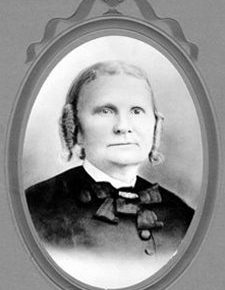
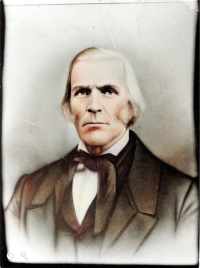
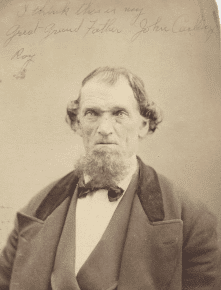
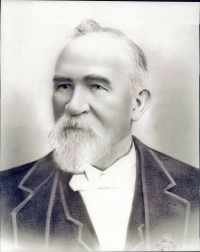
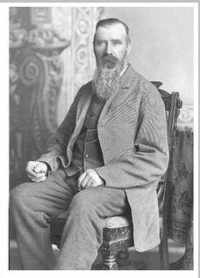
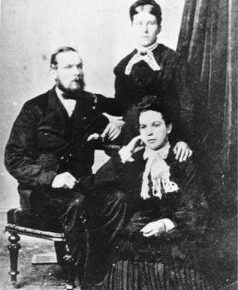
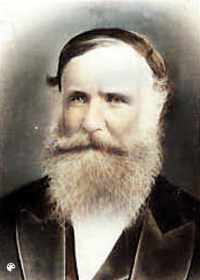
William Henry Adams, Sr.

William Henry Adams, Sr., was one of the first three settlers of Pleasant Grove on July 19, 1850 with Philo T. Farnsworth and John Mercer. He scouted the area along Provo River and came back with his report of straight logs for houses, and rocks for foundations. He surveyed the town site with these two assisting and set his own stakes for forty acres.
0 1
Read Time:4 Minute, 4 Second

William Henry Adams, Sr., was one of the first three settlers of Pleasant Grove on July 19, 1850 with Philo T. Farnsworth and John Mercer. He scouted the area along Provo River and came back with his report of straight logs for houses, and rocks for foundations. He surveyed the town site with these two assisting and set his own stakes for forty acres. He was a stonemason and assisted in the erection of the first stone and adobe buildings in Salt Lake City. He also assisted in the erection of the Pleasant Grove Meetinghouse in 1855, which later burned in 1871. In the spring or summer of 1858, when the army settled at Camp Floyd, he worked for $3.50 per day as a mason building the barracks. He built an adobe house on Pleasant Grove's Main Street and Third South in the early 1860's. He bought one of the first "wick" lamps in Pleasant Grove when candles or fireplace was common for light.

In 1861, he laid up the adobes from the first two school houses to build the third.

Then in 1880 he laid up the adobes assisted by his son Joseph H. Adams when the second (middle) room was added to this third school house. It was also used as a community center. He was also a musical entertainer (singer).

He served his country well and did the city of Pleasant Grove a great deal of good, for he built many buildings for the people and was always willing to take anything they had for pay. He left a mark of buildings all over town and elsewhere that will stand for ages.

Although he never went to school a day in his life, he worked to become self-educated. He was good in reading, writing, spelling and figuring.

He served eight terms as treasurer and tax collector of Pleasant Grove. He had the name and confidence ofthe people of keeping his accounts as straight as a shingle. He was secretary of the High Priests Quorum for many years and kept all the minutes.

He would have no trouble with any man. Although they would wrong him, he never had a law suit in all his life. He was as well respected for his faith, honesty, and uprightness as any person by everyone that knew him, and there were many.

He went to his grave without owing any person on the earth one cent. He was always honest in paying his tithes to the church. The first year he entered the valleys, Brigham Young called for a double tithe and he paid his to the cent, as near as possible.

He could converse with anyone on the history of nearly all nations. His mind was clear to the day he died. Although he was on his sick bed for nine months, he said he did not fear death and he died a true Latter-day Saint.

William Henry Adams, Sr.

B: 4 June 1817 in Dover, Kent, England

D: 8 Oct 1898 in Pleasant Grove, Utah, Utah

Father: John Adams

Mother: Mary Nash

Spouse: Martha Jennings

B: 24 July 1808 in Dover, Kent, England

M: 3 November 1839 in St. Mary's Parish, Dover, Kent, England

D: 17 Aug 1852 in Pleasant Grove, Utah, Utah

CHILDREN:

Mary Adams

B: 1 February 1841 in Dover, Kent, England

D: 1 February 1841 in Dover, Kent, England

Martha Adams

B: 1 May 1843 in Dover, Kent, England

D: 19 September 1843 in Dover, Kent, England

William Henry Adams, Jr.

Chr: 26 June 1845 in S10 Mary's Parish, Dover, Kent, England

M: 22 March 1869 to Melissa Jane Caldwell in Salt Lake City, Salt Lake, Utah

D: 2 November 1921 in Pleasant Grove, Utah, Utah

Eliza Adams

B: 6 October 1847 in Dover, Kent, England

M: 11 Aug 1865 to George Aker Huggins in Salt Lake City, Salt Lake, Utah

D: 22 January 1913 in Fountain Green, Sanpete, Utah

John Alma Adams

B: 5 August 1850 in Salt Lake City, Salt Lake, Utah

M: 29 July 1877 to Mary Alice Frampton in Pleasant Grove, Utah, Utah

D: 4 August 1935 in Pleasant Grove, Utah, Utah

Spouse: Francis Ann Otten Crossland

B: 8 February 1824 in Redlion Street, London, Middlesex, England

M: July 1858 in Pleasant Grove, Utah, Utah

D: 23 January 1903 in Pleasant Grove, Utah, Utah

Children: 1.

Alice Maria Adams

B: 14 May 1859 inPleasant Grove, Utah, Utah

M: 22 October 1877 to Joseph Ephraim Whiteley in _

D: 29 December 1924 in _

Annie Jane Adams

B: 10 Mar 1861 in Pleasant Grove, Utah, Utah

M: 25 September 1879 to John Henry Newman in _

D: 17 August 1927 in _

Joseph Hyrum Adams

B: 22 Feb 1865 in Pleasant Grove, Utah, Utah

M: 4 June 1888 to Colinda Chrilla Rogers in _

D: 31 July 1950 in

Happy
Happy
0 %
Sad
Sad
0 %
Excited
Excited
0 %
Sleepy
Sleepy
0 %
Angry
Angry
0 %
Surprise
Surprise
100 %
You May Also Like

BELLISON, James Thomas and Louisa

Before many days, an incident occurred which tells a lot about James' attitude toward draft animals. His granddaughter, Pearl Allen Read, tells of the company coming to a bog of mud in the trail which caused many wagons to get stuck. As each team came to the bog, the Captain standing there would join the drivers in whipping the animals to get them through.When it was his turn, James forbade the Captain. "These are my animals and no whip is to be used on them." Although James' team pulled through the bog successfully, the Captain was angry and thereafter continued to find fault with this independent member of his company.James Thomas' life-long insistence that his animals be treated well was admired by those who knew him and was learned and perpetuated by his children throughout their lives.
View Post

POND, Stillman Pond

On February 2nd 1846 the migration west began. Stillman and his family remained in Nauvoo until after the battle of Nauvoo in September 1846 when they were driven at the point of a bayonet across the river. Tribulations and hardships were many as the winter set in early and the Mormon refugees were without the proper food, clothing and shelter. The camp was ravaged by malaria, cholera, and consumption. The Pond family fell victim of all of these diseases. Stillman’s wife, Maria, became consumptive and all the children were afflicted with malaria. Snow fell early on the plains of Iowa and along the way Stillman and Maria buried their son Lowell Anson in September of 1846 on the plains of Iowa. Maria’s body wracked with pain and bowed down with grief for the loss of her son; was unable to walk and was confined to her bed in the back of the wagon with the fever of malaria. In this condition she gave birth to twin boys Joseph and J. Hyrum, the later part of September and the twins died a few days later and were also buried along the trail in Iowa.
View Post

CARLING, John Witt

Wagons for Fleeing SaintsJohn Carling and his son Isaac worked at making and mending wagons for the Saints who were being driven from Nauvoo. The mob violence became so intense that the Carling family decided to leave with the main body of saints. Brigham Young sent Heber C. Kimball to inform John that if he would stay until all of the Saints had been provided with good outfits, not a hair of their heads would be harmed. They remained as requested, though some wives complained that they would all be killed. “The morning they were to leave, they were counseled to get to the ferry boats before the mobs were astir, and upon arriving at the ferry, the captain hurried them onto the boat and admonished them to be quick because they could see the mobs coming. Some were on horses, and others were running, but all with guns in their hands, and they were cursing. As the saints left the shore, they could hear the leader of the mob ordering his men to shoot. But as the men came to the shore, they stood still. It is told by some that two shots were fired but they missed the people in the boat.”
View Post

ALSON, Thomas

At the time there were no free schools held in Utah, so students were required to pay tuition, which was rather difficult to provide; while attending with Peck, my tuition became considerable in arrears, therefore, he proposed that I assist him with classes at a salary of $1.00 per week and my tuition, (in all about $1.35 per week) the $1.00 per week to apply on deferred payments.I engaged to teach the Hoytsville School early in January 1876, at a salary of $45 per month. The school house consisted of one log room about 30 by 40 feet, heated by a stove in the center. The teacher was also the janitor etc.
View Post

BAMBROUGH, Annie

Submitted by Paul Bambrough Joseph Bambrough and Margaret Charlton were coal miners in Northumberland England.  They heard about opportunities in America and in 1864 arrived in Pittsburgh, Pennsylvania. Annie was…
View Post

HOWARD, Joseph

A canal ran between and divided the 5 acre farm from that of Joseph's father, William. A pleasant pastime of the children was to watch the horses as they pulled the loads of freight and coal in boats along the canal. Locks were located near by and it was such fun to see the boats raised and lowered as they proceeded on the journey to the big cities.
View Post

ALLEMAN, John

JOHN ALLEMAN and his family arrived in Nauvoo in 1838 from Pennsylvania with two wagons, ten horses and their household possessions. He bought farm land and built a brick home for his family. He assisted in building the Nauvoo Temple and served as a cavalryman in the Nauvoo Legion.
View Post

WOOD, George Lymer: An Incident in the Life

"The usual method of disposing of the dead was to weight the bodies and dump them overboard. When others and I asked the privilege of removing our dead and burying them on land, the Captain was hateful and mean about it. All of my dear ones except Samuel's wife I had to perform this last earthly service for. Others of the party had sustained like losses, and were as anxious as I to bury them as decently as possible. The Captain at last agreed to wait and we hired a Negro to help dig a trench big enough to put them in all together. We removed the dead from the boat and began our heart¬breaking task, but had it only partly done when the boat whistle blew and the boat began to get underway. All ran hastily back except the Negro, one woman and myself. She and I stood at the grave site of our dead and watched them go. What bitterness of spirit I experienced only God knows. Was this what I had come to America, the home of the brave, for? Here I was with two strangers standing beside the open grave of a group of strangers. Our common interests were all lying before us or fast receding from sight, subject to the whim of a heartless thing in human form. "Surges of emotion swept over me, sorrow, anger, love, fear, and despair, but my nearest duty was to protect these rapidly decomposing dear forms of mine from the ravages of wild beasts, heat, and other elements. Perhaps I had been blessed and spared to perform this last service. If! were dead with them our bodies would rot together. So I urged on my companions the need for work. I felt responsible for seeing this thing through.
View Post