 0
0
 1
1

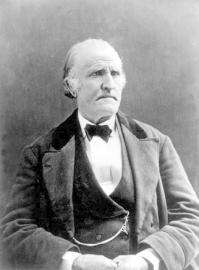
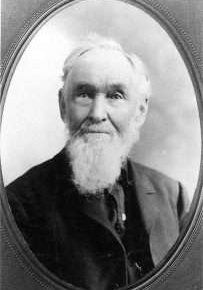
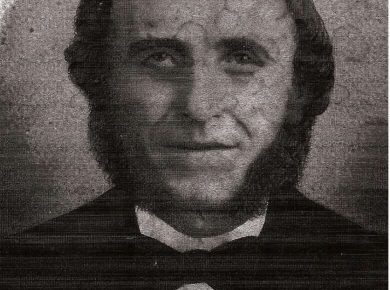
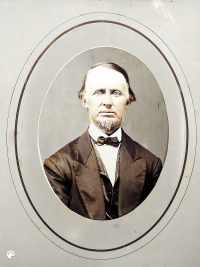
John Parker Jr., was born February 14, 1812 in Chaigley, Lancashire, England, the sixth of ten children. As members of the Anglican Church, the Parker family attended regularly; John Parker, Sr. led the choir and several of the children sang in it.
In his early years John, Jr. herded cattle and sheep and rented a small farm. He had no schooling, but was taught to read and write at home and through self-teaching.
In 1834 he married Alice Whitaker. Six children were born to them; the first three died in infancy. Alice died with the birth of her sixth child.
The first Church Elders arrived in their village in 1837 and stayed in the John Parker, Sr. home. The pastor invited them to speak to his congregation. He said,
“The Elders deluded all the best of the congregation.”
Most of the choir converted including the pastor’s daughter, Amelia, who married Willard Richards. John Parker’s parents, his sisters, their husbands, and many friends were baptized by Heber C. Kimball in March, 1838. John watched the baptisms and said that he wished he had clothes so he could be baptized. He borrowed his sister’s dress and was baptized. He said wearing the dress was worse than the icy water.
When the first ship left England to bring Saints to America, John, Sr., his wife and some children sailed and settled in Nauvoo. John, Jr. and his living children, William, Elizabeth, and Mary Ann remained in England as one of John’s sisters, Mary, helped tend them.
On January 17, 1843 John and his children sailed for America. It was a rough passage; he and his daughter Elizabeth spent much of the voyage being sick. Upon arrival at Nauvoo, John’s mother helped with the children until she became sick with Ague and passed away.
Ellen Briggs Douglas, a friend of the Parkers from England, was a widow of George Douglas ane had several children. She and John were married by Samuel W. Richards in 1844 at Nauvoo. She bore John three additional children. When they married, John had 50 cents and Ellen had one cow.
Upon leaving Nauvoo they traveled to St. Louis where a daughter, Alice, was born in January, 1848. A son John was also born before they left St. Louis in 1852. He died eleven months later. At St. Louis John went into the soda water and root beer business and became prosperous. In the spring of 1852, he sold his business and outfitted a private family company to travel to Utah. There were 11 wagons two yoke of oxen to a wagon, a thrashing machine and a cook stove. John, Ellen and two children rode in a spring carriage drawn by two horses. The company consisted of John, Ellen, all their children, and some brothers and sisters and their families. They arrived at Salt Lake August 28, 1852.
Brother Parker bought a lot on 200 South and West Temple where he built a home large enough to hold dances without having to move furniture. He bought a farm from Orson Hyde near the point of the mountain and built a saw mill northeast of Bountiful where with his partner, James Jepson, they made lumber, lath, shingles, pasteboard and paper. When Johnston’s army arrived at Camp Floyd in 1858, John resumed his soft drink business selling his product to the army. He remarked,
“The Army not only brought goods, but the money. What our enemies meant for our destruction proved to be a blessing in disguise.”
In 1858 John married Maria Jackson Normington who came to Utah in the Martin Handcart Company of 1856 where she lost her husband and three sons. She and her three daughters survived. Two children, Richard and Maria, were later born to John and Maria.
At conference on October 6, 1862 Parkers were called to Dixie to raise cotton. Initially, John took only his wife Ellen and her daughter, Alice. Maria and the rest of the family moved to Virgin in October, 1863.

The home in Virgin was made from an abandoned cellar that had caved in. It was cleared out, John propped it up with cottonwood poles, put in windows, a flat rock floor, a door frame and attached a linsey blanket for the door, the roof was cottonwood limbs and dirt. They lived in this dugout until 1867. John was instrumental in establishing the first co-op store on the upper Virgin River and the Kolob Cattle Association.
In 1867 John Parker became the first bishop of Virgin and served until his death March 24, 1886. His daughter wrote,
“We are thankful to have been born of parents who taught us by example and precept to be honest and live according to the principles of the gospel.”


 Brother Joseph