This article originally appeared in Pioneer Magazine, 2010 Vol.57 No.3
by Wendell A. Bryce
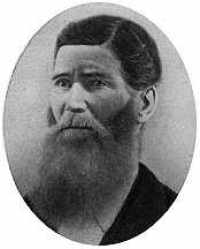
Ebenezer Bryce was born in Dunblane, Perthsire, Scotland, on November 17, 1830. His parents were Andrew Bryce and Janet Adams. Ebenezer was the third child of eight children.
At 10 years Ebenezer began working in the shipyards. At 15 years he became an apprentice. In the spring of 1848 he became interested in The Church of Jesus Christ of Latter Day Saints. His father, family and friends did not share his enthusiasm. His father would lock up his clothes to keep him from attending the meetings. He was baptized in April and was determined to go to Utah. His father followed him on board a ship to persuade him not to go. but he was still intent on going.
Ebenezer came to the U.S. in the John Sharp Company arriving in New Orleans on October 27, 1848, aboard the “Erin’s Queen” from Liverpool with 232 souls. While in St. Louis he was ordained a Seventy on February 27, 1849. In March 1850 he started westward, traveling in the James Pace Company. They arrived in Salt Lake City September 16, 1850. No record of the company’s travels is known.
On April 16, 1854, he was married to Mary Ann Park by George A. Smith in the Smith home. The new couple made their home in Salt Lake City where Ebenezer began working as a carpenter and millwright. He was soon asked to go to Tooele to work on a sawmill. In March 1856 Ebenezer was listed as a private in Company A of the Tooele Top Battalion of the Nauvoo Legion. The family moved to Spanish Fork, then Mill Creek.
At the October Conference in 1861 he heard his name read along with others to go to Dixie in southern Utah and help settle that area. This must have been a particularly trying time. They had four young children with the oldest about 6 years. Another child was expected very soon. They arrived in the present area of St. George in early December. The city consisted of 7 tents before their arrival. Then there were 40 days of rain! —while camped in a wagon with four young children and a baby. In the spring they were then called to go to Pine Valley about 30 miles to the north to build sawmills. There he and Sam Burgess erected the fourth sawmill in Pine Valley.
It was about 1865 when Bishop William Snow asked him to design and be the builder for a Pine Valley Chapel. Ebenezer had not built any large buildings, but said, “If you will let me build it like a ship, I’ll build it.” He was told to go ahead.
They hand picked some trees from the gorge at the lower end of the valley on Santa Clara Creek. Because of the confines of the rock walls, the trees grew tall and straight. These trees were too large for the sawmills to cut, so they were squared into timbers with broad axes.
The sides of the church were built laying on the ground. To raise the sides into place, Ebenezer had a call that was used on ships. Ropes were attached to the sides and the call used to get everyone to pulling together to raise the sides. The building strongly shows his shipbuilding influence. Ebenezer said, “It might burn, it might float in a flood, it might tip over in a hurricane, but it will not break up.” The lower story was used as a school for many years and the upper story as the chapel. It is shown on aeronautical charts as a landmark to guide the aircraft pilots.
One of the little boys that went to school in the building would later develop the skip bombing technique that was used so successfully in World War II.
[Ebenezer was] advised to seek a warmer climate for Mary Ann’s health. [He] traded his home (which is still in use today) to Henry Slade for sheep and moved to the Paria River in Garfield County.
In developing water for home and irrigation, Ebenezer and two sons went up the creek until they found a series of springs. They set about cleaning these springs and developing more flow.
As they were working Ebenezer decided to go up the canyon further and explore. He was gone a long time, and when he returned he described the fantastic shapes and colors and said,
“Someday that will be a national park.”
Bryce Canyon Utah National Park United States
[“A group of families established the town of Clifton near the junction of the Paria River and Henrieville Creek, in 1874. Ebenezer Bryce and his family arrived in Clifton in 1875, but soon moved upstream to Henderson Valley (New Clifton). Ebenezer helped to complete a seven mile irrigation ditch from Paria Creek. Bryce built a road into the pink cliffs to make timber more accessible. People started to call the amphitheater where the road terminated, ‘Bryce’s Canyon.’ Ebenezer Bryce and his family moved to Arizona in 1880, but the Bryce’s Canyon name stuck.”1
The family had moved about two miles north of Pima, Arizona, where the settlement of Bryce is named in his honor. It was there that he died, in 1913, and is buried in Bryce Cemetery.
Bryce Canyon became a National Monument in 1923 and a full-fledged National Park in 1928.2]
Written by Wendell A. Bryce, March 9, 1983, excerpts from the family history of Jerry and Barbara Waters Cornia at http://barbcornia.com/genealogy/ getperson.php?personID=I183&tree=barb
Cited from National Park Service, Bryce Canyon at http://www.nps.gov/brca/historyculture/pioneer_history.htm
This article originally appeared in Vol.50, No.1 (2003) of Pioneer Magazine. by Janet Peterson The Prophet Joseph Smith often referred to Eliza R. Snow as “Zion’s poetess.” When she joined…
Thomas Kirk Armstrong was instrumental in developing the Utah territory with his team and wagon, his sawmill work, and in the sheep business at a location about seven miles east of Park City, Utah. He also maintained a dipping vat that all sheepmen used to dip their sheep in. They used a solution of tobacco and sulphur
Enos live a wonderful life, enduring the trials of crossing the plains, becoming a Patriarch, and helping to build up the Kingdom of God in Utah. He helped to build the city of Springville, Utah, and went with Brigham Young to the South of Utah, coming back in the winter of 1856. He didn’t feel well that spring, but kept on working.
John R's mother was ill and stayed in Winter Quarters, but John R and his brother Franklin W ( 8 ) left soon after the advanced party, in the Jedediah M Grant Company. In his book John R. states that they were no ones responsibility, but everyones chore boys. It is heart renching to me to picture a sick mother sending a 10 year old son on a 1000 mile treck through wild country with an 8 year old in tow. One morning when they were camped on Hams Fork near Ft Bridger, in what is now Wyoming, a cow was sick and would not get up. John was left behind to try to get her up and bring her to the next camp site. It is terrible to think of the fear he felt as the last dust settled from the wagons as they faded from view. While tending the cow he saw an Indian across the river, and he decided to leave the cow and head for camp. The next morning several men returned to the previous camp site, and found that the cow had been butchered by Soux Indians 'on the war path after Shoshones', This band raided Ft Bridger, but left the Mormon train alone except for one sick cow.
The road was to follow an old Indian trail on the west edge of the Black Ridge. When asked how the wagons would get across the deep canyon which barred the way, he replied, “We’ll leap it!” The 165 ft deep canyon crossing became “Peter’s Leap.” The stream became “Leap Creek.” A sturdy windlass was erected on top of the north canyon wall. The wagons coming from the north were stopped here. The cargo was lashed securely to the wagon box. The teams were unhitched and led down the winding 30 percent grade to the canyon bottom.
Submitted by Larry Gibson, past president, Timpanogos Chapter My great-great-grandfather, Allen Stewart (Stuart) Adamson, was born April 29, 1823, at Dundee, Scotland. He was the son of James Adamson, born…
In most respects William Wadley was typical of many other people who joined the LDS Church in the mid-1800s in England. Many of them migrated to the Utah Territory, many…
Much fanfare accompanied the completion of the transcontinental railroad at Promontory Point, Utah on May 10, 1869. Two weeks later Major John Wesley Powell and nine companions in four row boats left Green River, Wyoming, with almost no fanfare, to explore the Green and Colorado Rivers. It was a trip fraught with danger that only six of the men completed. Although not involved in running the river, my great uncle, Nathan Adams, would later share the adventures experienced by Powell’s second exploration crew as they mapped the Grand Canyon area during the 1870s. A hundred and forty years later only a few intrepid tourists visit Promontory Point each year, while tens of thousands of tourists, many of them from foreign countries, enjoy the marvelous scenery discovered by Powell and his colleagues.
Combined with the guarding that was surely required of Moses, we also learn from George Thomson’s biography that “Moses pushed and pulled on a handcart with a sick man in it for many days. Their rations got slimmer . . . When they got to the Sweetwater [River] near Devil’s Gate, Moses died with seven others the same night. . . . they were buried in shallow graves and covered with snow. This tragedy was a terrible blow to George and he did not get over it for years.”
Submitted by Hudson Bradshaw, a student at Arrowhead Elementary School in Santa Clara, Utah. Robert Kirk Anderson I’ve never met my great grandpa Bob, but I’ve heard that he was…
Born: Jan 22, 1804 in Bastard, Leeds, Ontario, Canada Died: April 15, 1889 in American Fork, Utah Arza Matson Adams- Pioneer Flour Miller and Millwright Arza Matson Adams was born…
Submitted by Cal Andreasen Born: Jan 21, 1875, Torslev, Hjorring co., Denmark Died: Aug 28, 1961, Provo, Utah The Jens Christian Andreasen Family Immigrated America, 1889-1891 DANISH ANCESTORS I think…
In order to support herself and her family of small children, Jane made cookies, cakes, and bread which were put into small home made baskets and the children would sell them to regular customers and at the Southern Down Resort. In order to have a variety of cakes, the mother and children would go down to the seashore when the tide was out and gather larva from the rocks. This substance looked somewhat like lettuce. They washed the sand from it and put it into baskets and buckets. It was later baked as part of the cakes. These children thought nothing of walking three or four miles and selling this food for a schilling a pound. Sometimes Cecilia and Ann worked as nurse girls and as ladies maids.
While the wagon train was stopped one day for a rest Elizabeth and her girlfriend had taken their knitting and gone down alongside the creek to set in the sun. They looked up from their chattering and laughter to see an Indian watching them. Then he disappeared. Upon their return to camp, the Indian was in consultation with Captain Zebriski. Then later the Captain reported to Elizabeth their conversation. The Indian, attracted to Elizabeth had said to the Captain, “Heap wino squaw, she knit socks, me want her.”
Samuel Humphries 1846-1928. Samuel Humphreys was born in Mansfield, Nottinghamshire, England, Jan. 31, 1846. His parents, Thomas, and Mary Sudbury Humphreys joined the church and left England to join the…


 0
0
 1
1
 Ebenezer Bryce was born in Dunblane, Perthsire, Scotland, on November 17, 1830. His parents were Andrew Bryce and Janet Adams. Ebenezer was the third child of eight children.


 Brother Joseph