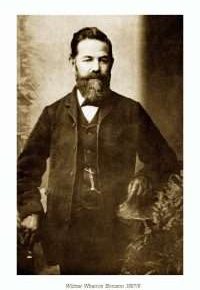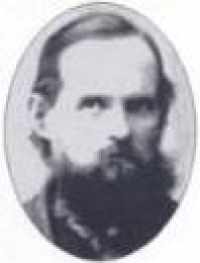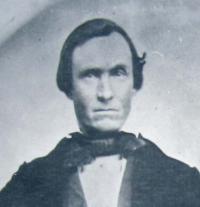
GLEASON, John Streator: Rush Valley Miner

John S. Gleason did indeed own the Mountain Lion mine, or parts there-of, but also the Blue Wing mine listed above and much to our surprise, at least seventeen other lodes shown in Figure 13.0. Two miles north of Ophir is Jacobs City in Dry Canyon. Some of the richest lodes of the Ophir Mining District came from this location. John S. Gleason owned in part the Iris(Ira) and Jacobs Hill lodes (Shoo Fly) in Dry Canyon. Millions of dollars of rich metals were taken from the Ophir and Jacobs City locations. The date of sale of the Mountain Lion Lode no. 2 was 4 March 1871. It was sold with the webster and women rights lodes for $2,000 dollars. The Mountain Lion Lode and thirteen other lodes were sold on 10 June 1871 for the combined sum of$5,000 dollars.
0 1
Read Time:3 Minute, 8 Second

Mining in Rush Valley

John Streator Gleason (1819-1904)

One of the premier days of my life is the day I took my mother (Marie Gleason Bennett) to Ophir City in the County of Tooele. It was here that, family tradition has it, John Streator Gleason sold his “Million Dollar” gold mine, the Mountain Lion Mine, in the year 1873 and used the proceeds to purchase the family farm in Pleasant Grove City. She had relived this story over and over and was delighted to see the City of Ophir.

Ophir Utah

What information could I find by searching the Internet? The Goshuite Indians lived in the area before the white man came. They had some ornaments and bullets made of silver, which they had mined from local exposed ore. General Patrick Connor and his troops, led by the Goshuites to the East Canyon of the Qquirrh Mountains, made some of the first claims. This area was known as Rush Valley and then Ophir in 1865. The Ophir Mining District was organized in 1870, and by 1871, more than 2,000 mining claims had been staked. The chief metals were lead, silver, zinc, and very small amounts of gold.

The Ophir mines were the Kearsage, Mountain Lion, Petaluma, Silver Chief, Tampico, Blue Wing, Velocipede, Shamrock, Miner’s Delight, Wild Delirium, Montana, and the Silveropities (Ophir Utah-Northern Towns). Wondering what aspects of the family tradition could be substantiated, my wife, Marilyn, and I visited the County Recorder in Tooele. We spent a delightful and informative day at the Tooele County Recorder’s office browsing through the mining records. We were able to confirm that John S. Gleason did indeed own the Mountain Lion mine, or parts thereof, but also the Blue Wing mine listed above,, and much to our surprise, at least seventeen other lodes.

Two miles north of Ophir is Jacobs City in Dry Canyon. Some of the richest lodes of the Ophir Mining District came from this location. John S. Gleason owned, in part, the Iris (Ira) and Jacobs Hill lodes (Shoo Fly) in Dry Canyon. Millions of dollars of rich metals were taken from the Ophir and Jacobs City locations.

The date of sale of the Mountain Lion Lode No. 2 was March 4, 1871. It was sold with the Webster and women’s rights lodes for $2,000 dollars. The Mountain Lion Lode and thirteen other lodes were sold on June 10th, 1871, for the combined sum of $5,000 dollars.

Finding 19 lodes partly owned by John S. Gleason raised the question; why was he mining in the Ophir District and was he an original claimant. Ore was “discovered” in the Rush Valley in the year 1865. John had returned from a mission in England in the fall of 1863, and he had time to explore new finds. John had been a selectman in Tooele County and was familiar with the terrain. As an officer in the Davis County Militia, he may have had contact with Army personnel who had “discovered” ore in Rush Valley. No matter the history, his interest in mining was extensive and spread much beyond the Mountain Lion Mine.

Recording mining claims was not federally required until 1870. However, the Rush Valley Mining District kept records of many claims prior to 1870. The Ira Lode and the Red Pine West Lodes show John S. Gleason as one of the original claimants over his own signature dated June 20, 1870, at 7 o’clock a.m. and May 24, 1870, at 8 0 clock a.m, respectively. The Mountain Lion Lode was filed on June 11, 1870. John sold his interest in mining in the years 1871–1872.

Happy
Happy
0 %
Sad
Sad
0 %
Excited
Excited
0 %
Sleepy
Sleepy
0 %
Angry
Angry
0 %
Surprise
Surprise
100 %
You May Also Like

MOLEN, Jesse: The Life and Struggles

Upon arrival in Salt Lake City they had very little food or other provisions. They were required to subsist on plant roots to supplement the little other food they had. The next year they experienced the cricket infestation and lost most of their crop. The rigors of the struggle to travel west plus chills and other conditions had taken their toll on Jess’s health.
View Post

ALEXANDER, Abel

Their two year old daughter, Edna, received fatal burns when a pot of freshly made tea was upset, scalding her chest. Due to the shock of the accident as well as the severity of the burn, she died on December 17, 1853. They had to use the funds they had saved to pay for the medical care and burial expenses for their little one.
View Post

WALKER, John

This article originally appeared in the Mar/Apr 1980 issue of Pioneer Magazine THE JOHN WALKER FAMILY—EARLY CHURCH STALWARTS by Rowland P. Corry The following is about John Walker, my great…
View Post

FREESTONE, George: and his Wives, Alice Carlisle and Jennie Lind

George found himself, as a fifteen year-old, driving four yoke of oxen on a heavy freight wagon to the Utah Territory. His younger brother, James, later wrote that he had driven sheep 1,000 miles barefooted across the Plains. “In Alpine,” George wrote, “between 1855 and 1856, I spent about half of my time building forts to fight against the Indians and half my time killing crickets.” The family struggled against these odds to make a living. Then in 1858, they lost their father when he was killed by Indians.
View Post

Richard Alldridge

He was evidently very happy in his work because he sang at it, wrote songs and occupied his mind and hands at the same time. His songs were songs of praise and thankfulness to his Heavenly Father for the many blessings received, and the knowledge he had of the true Church.
View Post

NIELSEN, Ane: A Self Sufficient Pioneer

Ane was a hard worker. She had to work more like a man than a woman. She did a lot of work in the fields and with the animals. When anyone in the family needed help or advice on the farm, they would ask her. She could fix a broken harness as well as any man. She had quite a few sheep that her boys would care for. She would shear her sheep, then wash the wool and spin it into yarn. Following this preparation, she would weave it into beautiful cloth.
View Post

HILL, Heamon Alison

During that time their father and baby Jasper died. They were so poor that they did not have enough money to bury their father and baby brother. “The Lord blessed us, for a man came to see us and seeing our plight, took us to his farm, gave us one room in his home, put our cattle in his pasture and buried our father and baby brother on his burying ground.
View Post