 0
0
 1
1

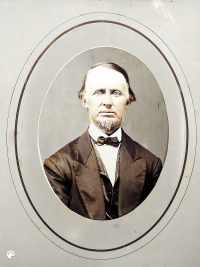
(1822-1891)
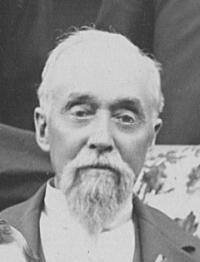
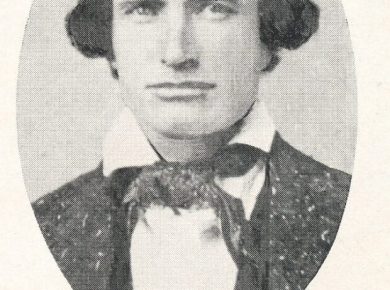
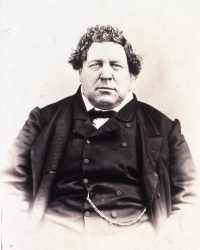
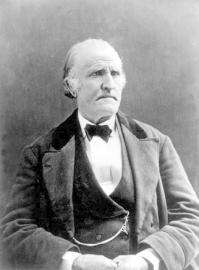
My great-great-grandfather, George Washington Hill, at the early age of 23, stood the test to live by principles he knew to be true. He remained true and faithful ever thereafter.
In 1845 in Dallas County, Missouri, after having purchased some land and built a small home, he began courting my great-great-grandmother, Cynthia Stewart. Says he,
“I proposed to her. Her answer was that she was a Mormon and that I did not want to marry a Mormon. I told her I thought Mormons were as other people; I believed Joseph Smith to be an impostor, but for all that I thought just as much of Mormons as anybody else. She gave me ‘The Voice of Warning’ by Parley P. Pratt …to read and then see whether I would think the same. I took the book to read, not thinking to find in it anything that would be of interest to me……But what was my astonishment to find that it claimed a perfect organization of the Church of Christ with apostles, prophets….that belonged to the church anciently and that I fully believed it would take to constitute the Church of Christ in any age……I became so interested in the book that I read it over and over again and wondered if I really was living in a day when the gospel was again restored to the earth…and there were men upon the earth that did commune with the heavens…the Spirit all the time bearing witness to me that the work was true……I determined to investigate it for myself….and if I found….that an angel had already visited the earth, I determined to cast my lot with them.”(1)
A short time later, George Washington Hill defended the principle of revelation in a church camp meeting when the minister challenged him. Cynthia Stewart then realized George was serious about the Church and agreed to marry him.
George and Cynthia were married on 18 September 1845. He determined to gather with the Saints as soon as possible, but every time they made preparations to depart, George came down with the chills and fever, symptoms of Malaria. After this happened three times, George decided to wait until spring of 1846. In the meantime, George learned of the Saint’s exodus from Nauvoo.
“In June of 1846, I bade adieu to home and friends…and launched forth into the wide world with a large family to care for and very little resources to do so, but placing my trust in God like Abraham of old, I started forth to a strange land, I knew not where, but determined to find the Church of Christ and identify myself with it….It did not matter with me if I knew I was right. I did not care what country I got to if I was able to find the Church.”(2)
George, Cynthia, and the Stewart family were heading north to intercept the Saints in Iowa. George had to take full responsibility for his wife’s mother and the large Stewart family. Cynthia’s father died in January of 1845. They journeyed through Iowa, George, not knowing where the Saints were, followed the impressions of the Spirit. They met the first Mormon Elders, Sam Brannon and Thomas Workman, at a place called Kelsey’s Mills. Trading their horses for oxen and obtaining more supplies they traveled on to Pisgah and then Winter Quarters.
A test of George’s faith occurred when George returned to Kelsey’s Mills where he had left his livestock. He found out that a Mormon fellow had killed two of his cows, a great loss to him for there was nowhere to replace them. When “I brought him before (the Church leader), who was there to preside, (and) was told plainly, that, as I did not belong to the Church,…my testimony could not be taken against one who did belong to the Church. This seemed rather hard for me to bear as if I could not tell the truth before being baptized. Still, I passed over it as well as I could.”(3) The families moved on to Winter Quarters, where, in June 1847 George requested baptism at the hands of Benjamin F. Clapp.
They arrived in the Valley of the Great Salt Lake in September of 1847 after the hardships of the journey west. The heavy responsibility and the sacrifices he made in that journey to gather with the Saints put 20 years of age on him in about two years, George remarks in his journal.
Two years later, in 1849, George decided to return to Missouri after receiving a letter from his father and brother. After counseling with Brigham Young, the President told him a company of missionaries was leaving soon for the east and that he could travel with them. He arrived at his parent’s home at Christmas time and found his father in very bad health. By early February, his father requested baptism, but became violently ill the night before his scheduled baptism and died. While in Missouri, George settled the estate of his wife’s mother, Ruthinda Baker Stewart. (4) Later all of George’s family joined the church, except one brother. George and his mother and brothers left for Utah in the spring of 1851.
(An interesting note: As George was traveling around Missouri settling the estate for his wife’s mother, he met Joseph Toronto and Lorenzo Snow who were on the way to Italy on a mission. (5) It was the mission to Italy of Lorenzo Snow that brought my great-great-grandparents, Michael Beus and Marianne Combe, and family into the Church)
Four years after arriving in the Valley of the Great Salt Lake in the spring of 1855 at the April conference George and twenty-six other men were called on a three-year mission to the Indians. (6)
They built Fort Limhi, later renamed as Fort Lemhi, some 330 miles north of their homes in Ogden, Utah. On their arrival at this location, “they found a large gathering of Indians, mostly Bannocks, Shoshones and Nez Perces, who had come …on their annual fishing trip. George W. Hill, who had learned their language, acted as interpreter and through him, the missionaries succeeded in making the Indians understand they had come to settle, they were their friends, and they had come to bless them by teaching them how to till the ground and how to build houses…”(8) The missionaries then assisted the Indians in making the traps to catch the salmon for their winter supplies of food.
George learned the language of the Shoshones and some other tribes with whom he and his fellow missionaries worked. Of an early encounter with a group of Indians, George notes,
“Since I had learned the a little of the language the winter before, it fell to my lot to do all the talking….that was done……I had accepted the mission in good faith and did not want to return with a blank record, so I turned in with a will to try and get the language, realizing that unless I could talk with them, my labors would not amount to much. I had faith in God that he would assist me if I would do my duty on my part. This I determined to do and it had been sealed upon my head that I should see them in the distance and should know them and that they would come to me by the hundreds, but little did I think that this was going to come literally to pass as soon as it did, for the first Indians we saw were at Fort Hall on the Snake River…..We had just encamped when, on looking over to Fort Hall, I discovered some Indians coming directly towards us, when it seemed to me that I knew them, and I told the boys (his missionary companions) who were with me that there came some of my children and that I was going to baptize them. This created some merriment among the boys…”(9)
The next day George was called upon to preach to the Indians, struggling with the language, but in spite of this, the Indians requested baptism at his hand, all in fulfillment of his prediction the previous day as he saw them coming in the distance. During his mission, he baptized over one hundred of them. (10)
By 1857 some troubles with the Indians instigated by the mountaineers and agents from Johnston’s army resulted in a bloody conflict with the Indians. In March 1858 an express group of ten men, including George, set out for Salt Lake City. They were ambushed by the Indians on the way, killing one of their party, the others escaped and continued to their homes. Fort Limhi was officially abandoned on March 28, 1858. (11)
In 1873 George was called again to work with the Indians. He assisted the Indians in establishing a place to build houses and farm because they did not want to live on a reservation. The land they obtained was near the city of Corrine, which was the central depot for the railroads east to west.
He loved the Indian people and defended their cause. A few years later, however, a false rumor of an imminent attack on the city of Corrine by those Indian people resulted in the Army forcing the Indians north and onto a reservation. That was heartbreaking for George, who sat in counsel with the Army Captain and the Indian leaders. Even though it was clear that false rumors had incited the people of Corrine, the Army forced the Indians to leave their houses and farms and go to a reservation. An ongoing battle between the gentile residents of Corrine and some of the Indian agents caused much sorrow for the Indian peoples whom George loved and worked tirelessly to help acquire land to farm and build homes where they could sustain their families. (12) The Shoshone honored George Washington Hill with a special name they gave him: Inkapompy, meaning “man with the red hair.”
After being forced to leave their farms and houses near Corinne, George began searching for another place for his Shoshone people to settle. He chose a place along the Malad river which became known as Lemuel’s Garden. (13)
Scott R. Christensen’s book, Sagwitch – Shoshone Chieftain, Mormon Elder, 1822-1887 documents the tireless efforts of George Washington Hill and others to acquire land where water could be brought by digging canals for these beloved people many of whom had been converted by George and his missionaries. Over the years hundreds of Indians from many tribes came to the home of George Washington Hill and requested him to come to preach the gospel and baptize them. He worked with them, taught them how to farm, and assisted in building canals to bring water to their homesteads. For some fourteen years or more, George worked, taught, blessed, counseled with, and helped those people. All the while the U. S. Government and some of the gentiles sought to force the Indians onto reservations, even though the Indians desired to become independent of the government through their own labors.
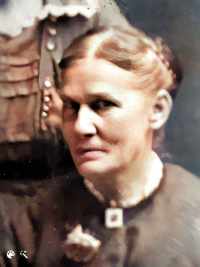
George Washington Hill, faithful defender of the Kingdom and friend and missionary to the Indian people, was born on March 5, 1822, on Federal Creek, Athens County Ohio. He died on February 24, 1891, in Salt Lake City. Nine years later, the wife of his youth, Cynthia Utley Stewart died on 8 April 1908. They were parents of nine children.


 Brother Joseph