 0
0
 1
1
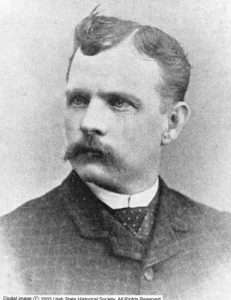
“Billy the Cartwheeler”, does some reminiscing
By HELEN MILLER LEHMAN, Improvement Era, July 1938

IN his tiny room in a fraternal home in northern California, sits a white-haired, pink-cheeked old man—William Harrison Culmer. He speaks of other days, not as many old men babble of the past, but with a virility of expression, a youthful flash of humor, and an amazing accuracy for detail. He has been a maker of history, and although his days of physical activity are past, he is still alert and keenly interested in present-day world events.
In 1852, Mr, Culmer was born on the Bay of Naples aboard a three-masted schooner of which his father was the skipper. The land home of the family was within a stone’s throw of the great London docks, in quarters over the Hagenback Zoo. To these humble rooms came such men as Charles Dickens, the novelist, and Oscar B. Young, the sixth son of Brigham Young.
As a boy, Culmer was better known as “Billy the Cartwheeler,’’ the title having been given him as the result of a competitive contest in the Crystal Palace, London, because of his ability to turn one hundred consecutive cartwheels, which exceeded the performance of any other boy in England. The iron strength of his wrists to this day testifies to his prowess.
His autobiography, now in the hands of a London publisher, is entitled “Billy the Cartwheeler,” containing reminiscences of Charles Dickens and the London Slums of his day, “by the last of the Dickens’ Boys.”
His impish personality and precociousness easily won him prominence. He stood at the head of his class of two hundred seventy boys in the Ragged School which he attended, and, when the World’s Fair of 1862 was staged at the Crystal Palace, he headed one of the groups of the 25,000 boys who made up the chorus. Mr. Dickens was one of the patrons of the Fair, and it was there that he first came in contact with “Billy the Cartwheeler.”
Arriving early at rehearsal one day, Dickens encountered Billy turning his cartwheels down the corridor. Finding himself with an audience, the child quickly left off cartwheeling, and stood innocently gazing at a great oil painting on the wall. Noticing the resemblance between the picture and the man who had approached (for the portrait truly was of Dickens), the boy covered his embarrassment by plunging into conversation. Culmer well knew his Oliver Twist, which was then being hawked on the street corners each Saturday noon, at one penny each installment of the serial.
“It’s a very good picture of you, Mr. Dickens, and I know the exact chimney where Bill Sykes hung.”
Staggered by hearing the boy say he knew the exact location of something which, of course, never existed, he asked: “Where did you say that was?”
“Do you know where the Greyhound Bridge is, Sir?” continued Billy.
“Indeed, yes,” was the reply.
“Well, Sir, do you know the big redbrick house on the other side of the race?”
“Yes.”
“And the big chimney on top of it? The only chimney on the house?”
“Yes, the only chimney on the redbrick house.”
“Well, it was right there that Bill Sykes hung,” triumphantly announced the lad.
“Well, well,” chuckled Dickens, “isn’t it strange? I had almost forgotten where it was myself.”
This incident led to the inclusion of “Billy the Cartwheeler” in an intimate group of young proteges which became known as “The Dickens’ Boys.”
At ONE time when Billy had been called to meet his benefactor, Dickens kept the appointment in company with William Wilkie Collins, the peer of all detective writers, who later became the novelist’s son-in-law.
“And is this your boy?” Collins asked.
“Not my son,” was the reply, “but one of my boys,” and it was in this fashion that Mr. Culmer was always introduced. At one time, for three months, he was a house guest at the home of the novelist.
The Culmer family also maintained a close friendship with Oscar B. Young, then an ordinary missionary, who had been sent abroad to assist his elder brother, Brigham Young, Jr., in the work of the European Mission of the Church of Jesus Christ of Latter-day Saints, with headquarters in Liverpool.
In 1863, the Culmers, who were loyal Mormon converts, crossed the Atlantic in the emigrant ship Hudson, an 800 ton barque twice condemned as unseaworthy. Seventy days were required for the crossing. Trans-shipping from New York in cattle cars, they were joined at the Missouri River by westward-bound immigrant groups numbering about one thousand persons from eastern Europe and our own southern states. Many were en route to Utah, others to the California gold fields.
The journey was an eventful one; Indians were encountered at North Platte, Whiskey Gap, and Cache Junction. Culmer mentions with pride that he was given a cayuse as The Last of the “Dickens’ Boys” his share of the booty at Whiskey Gap, where the Indians stampeded one hundred forty-seven of their mules, and burned many of the caravan wagons with flaming arrows.
The population of Utah at the time of the family’s arrival did not exceed 20,000. About seven years later, in 1870, Mr. Culmer was ordained an Elder in the Church.
At various times the Culmer Brothers controlled twenty-six important Utah business enterprises. In 1900, when William H. Culmer left Salt Lake City, he was superintendent and part owner of the Carbon Mines, Salt Lake Gilsonite Company, Utah Ozokerite Company, Assyrian Asphalt Company, Kyune Graystone Company, Mt. Stone quarries. Products from all these were developed and used by the Culmer Paving Company of Salt Lake City and Chicago. This Company also furnished Kyune stone for city and county buildings of Salt Lake.
Culmer was acquainted with Brigham Young and many of his family. “Brigham Young,” he says, “was a man of great force, remarkable foresight, and splendid executive ability, which qualities laid the foundation for the substantial growth and material prosperity of Mormon settlements throughout the State.”


 Brother Joseph